A First Visit to a Small Exhibition
A first visit to a small exhibition can feel unhurried: choose one work to revisit, notice its materials and leave space for a response that stays open.
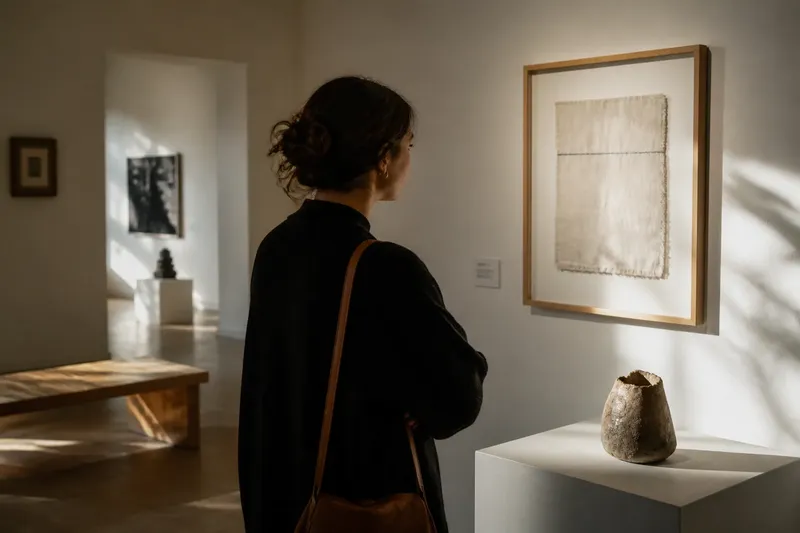
You step into a small exhibition, hear the door settle behind you and find yourself facing a room with no obvious route through it. A first visit to a small exhibition need not become a march from label to label. Choose one work to return to, let its materials hold your attention, and allow your response to remain unfinished.
The numbered suggestions below are invitations, not a test of how much you have seen. Take what suits the room and leave the rest.
1. Let the room set the pace
Before deciding which work matters most, give yourself a moment to notice the room as a place. Is the light soft or bright? Are the walls close together, or does the space open around a central plinth? Is there a bench, a quiet corner or a doorway through which you can see another part of the exhibition?
These details can help you settle without needing to make an opinion. You might pause near the entrance, move to one side to let someone pass, then take in the room from there. In a modest exhibition, the arrangement is often part of the encounter: a small drawing placed alone may invite a different kind of attention from a cluster of objects on a shelf.
There is no need to find the “right” order. A visitor who starts at the far end has not missed a secret route. Notice where you naturally slow down, and treat that pause as a useful clue rather than a commitment.
2. Choose one work to revisit
Select a work that holds your attention for any reason. It might be a painting that feels unfamiliar, a textile with a loose edge, a photograph whose subject you cannot quite place, or an object that seems ordinary until you look twice. You do not need to know whether you like it.
Spend a first moment with it, then continue around the room. Later, return to the same work from a comfortable place. The gap matters: your eyes may have adjusted to the light, another piece may have changed how you read it, or a detail may come forward simply because you are no longer trying to decide what the work means.
Imagine you notice a small clay form near the end of a shelf. At first it seems plain, so you move on; later, you come back and see a faint line pressed into its surface. You might leave thinking the line looks like a mark of making, or you might remain unsure whether it was intentional. Either response gives you something specific to carry away without turning the visit into a puzzle with a required answer.
3. Look at what it is made of
Materials offer a way into a work that does not depend on specialist vocabulary. Notice what seems soft, rigid, transparent, rough, reflective or worn. A piece of linen may hang differently from paper; a glazed surface may catch the light while an uncoated one absorbs it. These are observations, not clues that must lead to a single interpretation.
Look at edges and joins as well as the central image. Does a print have a visible border? Is a piece of wood cut cleanly or left uneven? Does a photograph sit behind glass, or is the paper itself part of what you see? Keep a respectful distance and follow any signs about touching or handling. A material can be read with the eyes; contact is not needed.
If a label names the materials, read it after looking for yourself. The words may sharpen what you noticed, or they may make you see the work differently. If the label is brief or uses terms you do not know, you can still stay with visible qualities: matte, fibrous, layered, stitched, chipped, folded. Where a label, maker’s instructions or local rules determine what visitors may do, follow them.
4. Read the label in two passes
Exhibition labels can give you a foothold, but they do not have to be your starting point. First, look without reading. Then check the label for the artist’s name, title, materials or a short note about the work. This small pause lets your own first impression exist alongside the information rather than being replaced by it.
You can choose which details to keep. A title may open a possibility, while a date or material simply gives context. If the wording feels dense, read only a line and return to the object. There is no obligation to absorb every sentence or to remember names for later.
A label is one voice in the room, not a verdict on what you are allowed to notice. If its explanation and your response do not line up, let both remain present. That tension may be more interesting than trying to make your reaction fit the text.
5. Leave room for an unfinished response
Visitors often feel they should produce a neat reaction: beautiful, moving, clever, confusing. But you can leave with a question, an image or a feeling that has not yet found a name. “I keep thinking about the uneven edge” is a complete observation, even if you cannot say why it matters.
Try separating what you saw from what you inferred. “There are pale marks across the dark surface” describes a visible detail. “They suggest rain” is one possible reading. Keeping the two apart does not make your response colder; it gives you room to change your mind without dismissing what you noticed.
It is not worth the effort to force every work into a personal lesson or to search for a hidden message in each detail. Some works may not draw you in. You can acknowledge that plainly and move on, leaving attention for the piece you want to revisit.
6. Make a small note if useful
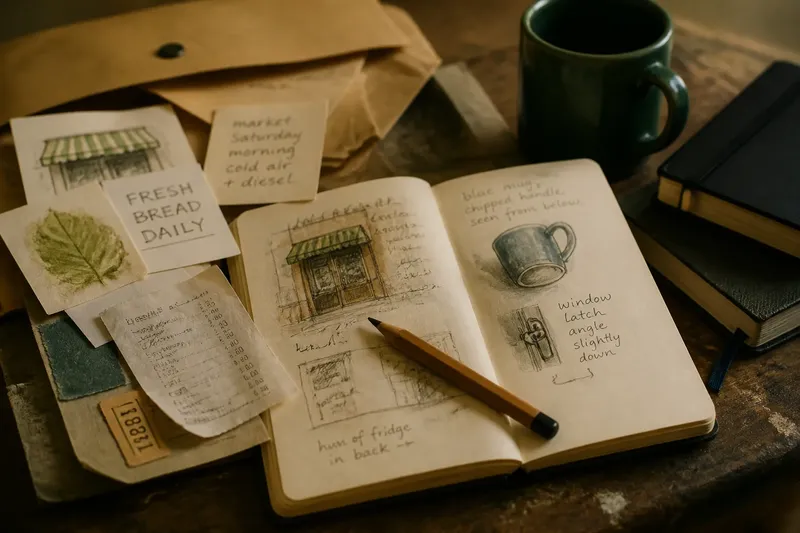
A note can help you hold onto a particular detail, but it need not become a review. On a phone or in a pocket notebook, write a few words such as “blue thread, loose corner” or “quiet room, clay line”. You might also record the title if you want to find the work again. Keep the note brief enough that you remain present in the room.
If you prefer not to write, pause and give the work a simple name of your own: “the bright window” or “the folded paper”. That private label can make it easier to recall later. Avoid photographing anything unless the exhibition permits it; a note is often more useful than an image because it records what caught your attention.
Say you have only a little time before meeting someone outside. You could pick one print, notice its uneven ink, read its label, then return once before leaving. The likely result is not a complete account of the exhibition, but a clear memory of one encounter and a question you can carry into the next part of your day.
7. Finish with a chosen pause
Before leaving, return to your chosen work if the room allows. Stand where you can see it without blocking anyone else, and notice whether your attention has shifted. Perhaps a detail is clearer; perhaps the work feels just as opaque. Either is a useful ending because the visit has changed from a first glance into a deliberate second one.
You might also look once across the room and notice which works you did not spend time with. There is no need to feel that you owe each one equal attention. A small exhibition can be met through one sustained encounter, a few quick glances, or a mixture of both.
Questions visitors ask?
How long should I spend in a small exhibition?
Stay for as long as your attention feels comfortable; there is no required duration. A single return to one work can make a short visit feel considered, while a longer visit may simply invite more pauses.
Do I need to understand the artwork?
No. You can describe what you notice and leave its meaning unsettled. If a label offers context, use it as one possible way to look rather than as a test you must pass.
What if none of the works appeals to me?
Notice whether anything catches your eye for a moment, even if it does not become a favourite. If nothing does, you can still take in the room or leave without inventing enthusiasm.
Can I write notes or take photographs?
Brief notes are a simple way to remember a detail, and they need not interrupt your visit. Photography depends on the exhibition’s rules, so check the signs or ask a member of staff before taking pictures.
A first visit to a small exhibition can be enough when one work stays with you for a little while. Let the materials, the room and your uncertain response accompany one another; you do not have to settle their relationship before you step outside.