The Sketchbook Before the Bound Notebook
Sketchbooks work best as private stores for observations and working ideas, helping you notice patterns and return to useful fragments without polishing them.
A bus lurches away from the kerb; the passenger opposite grips a paper cup, and a stripe of late light catches the lid. You jot “tilted cup, bright rim” in the margin of a receipt. That small notation belongs to the sketchbook tradition as much as a carefully drawn page: the sketchbook is a private place to gather what might matter later, not a stage for finished skill.
A place for noticing
A sketchbook gives passing observations somewhere to land. It might hold the angle of a window latch, three words overheard in a queue, a rough map of a market stall, or the outline of a leaf beside its shadow. The point is not to record everything. It is to catch the detail your attention has selected before it slips away.
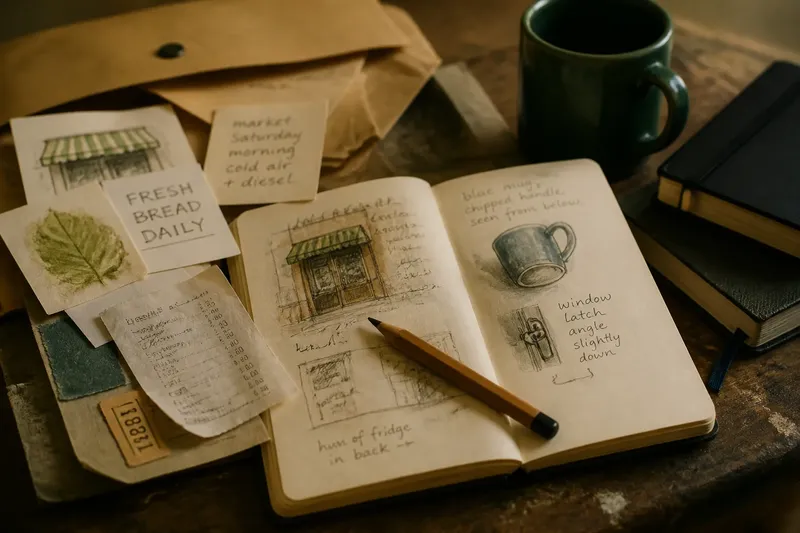
That selection can be more useful than a polished drawing. “Blue mug” says little; “blue mug, chipped at the handle, seen from below” gives you a shape, a colour and a viewpoint to work with. A few words beside a mark can preserve what your eyes noticed but your hand did not quite capture.
Keep the book close to the situations that generate ideas: beside the window, in a coat pocket, or near the place where you read. A pencil that does not need a sharpener is handy for quick notes. A small envelope tucked into the cover can hold a ticket, a leaf rubbing or a torn colour sample without turning each one into a finished composition.
Before the bound book
Some people make pages before they settle on a permanent notebook. A folded sheet, a pad of scrap paper or loose cards can feel easier to use when the subject is still taking shape. These temporary pages are not lesser records. They let you discover what kind of marks, notes and fragments you actually want to keep together.
Imagine you are collecting details for a drawing of a corner shop. Start with a receipt-sized scrap for the slanted awning, then add a card with the handwritten sign’s lettering and a few words about the hum of the fridge. If those observations begin to speak to one another, gather them in a notebook; if they do not, the scraps can remain separate. The expected result is a record organised by interest rather than by pressure to fill every page.
Loose notes also make room for different kinds of attention. A charcoal smudge, a written colour name and a quick plan of the doorway need not fit neatly into one drawing. The bound notebook can arrive when you want a durable home for a developing thread, not as a test of whether your practice has become serious.
Marks without polish
Let a page keep its working status. Draw over an earlier line if the new one clarifies the angle. Write a question beside a shape: “What if the shadow starts here?” Leave half a page empty for a later note. A sketchbook is allowed to show uncertainty, because uncertainty is often the useful part of the observation.
Try changing the scale of the note rather than making it more refined. A tiny plan of a room may capture the relation between a chair and a doorway better than a careful rendering of the chair alone. Arrows, labels and shorthand are legitimate tools; the page is for your future attention, not for an audience that needs every mark explained.
What is not worth the effort? Re-drawing a rough page merely to make the book look consistent. If a mark already tells you what you needed to remember, polishing it can consume the attention you might spend on the next observation. Keep a page only as tidy as its purpose requires.
Returning to fragments
A sketchbook becomes useful over time when you can revisit it without demanding that every page lead somewhere. Flip through slowly, and notice what keeps catching your eye: repeated curves, a particular kind of doorway, scraps of dialogue, or the way shadows divide a surface. A recurring detail can suggest a direction, but it does not obligate you to turn every note into a finished piece.
Use a light organising mark if browsing becomes difficult. A dot in the corner might mean “look again”; a folded page might hold a cluster you want to revisit. You can also add a short index at the back, listing a few subjects and the pages where they appear. Keep the system easy to ignore when you are in the middle of looking.
Sometimes a fragment makes sense only beside another one. A sketch of a stair rail may echo the curve of a shell drawn weeks earlier. Place the pages side by side, or copy a small motif onto a loose card, and see whether the connection opens a question. The sketchbook’s role is to make that encounter possible, not to declare the connection important before you have explored it.
Questions about sketchbooks?
What should I put in a sketchbook?
Record details you may want to notice again: shapes, colours, phrases, spatial relationships or quick questions. Words and diagrams can be as useful as drawings.
Do sketchbook pages need to be finished?
No. A page can hold an unfinished mark, a failed attempt or a note to return to later. Its value lies in helping you remember or think, not in looking complete.
Should I use a bound notebook or loose paper?
Use loose paper when you want freedom to sort, compare or discard fragments, and a bound notebook when you want observations to stay gathered in one place. You can move between them as an idea develops.
How can I find useful pages again?
Mark only the pages you want to revisit, or keep a small index of recurring subjects. Browsing without a strict filing system can also reveal connections you did not expect.
A record that stays open
The sketchbook before the bound notebook is not a special format; it is the moment when an observation is still allowed to be provisional. A scrap can become a page, and a page can remain only a page. Keep the record open enough for a later glance to surprise you, and precise enough that you can recognise what first drew your attention.